Run with Leroy: 10 km - 62.28 min, breeze, +19ºC, sunny.
Run with Strelka and Leroy: 10.47 km - 69.56. Cool breeze, +19ºC, but feels hot in the sun.
Endless distractions today with people walking dogs and many cars on the lane where there's usually none. Poor Strelka is limping and it's getting too hot for the dogs. As for me, I just enjoy the salty sweat dripping off my face and trickling down my spine.
The beginning of this year has been marked in Russia by a curious clash between groups of young runners and the authorities who regard mass runs organised through social networks as a form of protest.
Sober Russian may be an oxymoron. Consumption figures vary from 9.3 litres of pure alcohol per person per year to 18 litres, depending on who and how counts. But alcohol abuse is often cited as the main factor in Russia’s catastrophic demographic situation. The nation’s population has not been growing since 1991, but declining by several hundred thousand each year. Researchers attribute 600-700 hundred thousand deaths a year to alcohol.
Since mid-1980s there has been no serious concerted effort to stem the vodka tide. The problem has long been exacerbated by the fact that tax and excise revenue from alcohol sales is necessary to finance public spending. ‘How do we pay teachers and doctors, if we stop selling vodka?’ is one killing argument I’ve often heard. Another factor is the rich culture surrounding drinking which portrays excesses in a largely positive light.
From the beginning of this year groups of young men and women, mostly students, have been organising mass runs in city parks. They communicate through the internet social networks and bypass official channels. Runners seem to appear from nowhere and in numbers reach 200-400, sometimes up to a thousand. Participants chant the slogan ‘Russki znachit trezvy’ – ‘[being] Russian means [being] sober’. They warm up, run and some have dips in holes made in city ponds for Epiphnay rites. The atmosphere apparently is good-natured and the young people seem to be well-behaved.
This youth action caught officials unprepared and struggling to work out how to react. Nervous and tetchy after ugly race riots in Moscow last December, they took it as another ‘fascist’ or ‘nationalist’ demonstration. Police were sent in and arrests were made. The official reaction caused much amusement – and growing anger among the sober runners and general public.
Here is what an organiser of one recent run says on gradmar.ru web-site:
‘It isn’t correct to compare the new initiative with the story-line of, let’s say, Forrest Gump. The main character there was running across the USA ‘to get away from himself’, or if you will, ‘to find himself’ and later realised that there was no sense in what he was doing. Here we have a very clear aim, we know what we are running from and where to. Our action has a definite message – to dismantle the cast stereotype of a Russian as the moronic hard drinker.
The reaction of the authorities and law enforcement organs is bewildering. Does it mean that every runner-sportsperson who happens to be in the Botanical Gardens or any other Moscow park has to be checked to see if they belong to an ‘extremist organisation’? Or is it that the slogan ‘Russian Means Sober’ can be seen as extremist? What, with no other ethnicities mentioned, does it mean that to say to a Russian that he is sober is to humiliate and ‘insult the nation’?
So, now if a person sticks to a healthy life style, doesn’t drink, doesn’t smoke (no payments to the state through excise on vodka and tobacco), doesn’t watch [state controlled] TV (politically suspect!) and actively promotes these principles in society, then that person is an extremist! And even if that person goes further and creates a family (doesn’t spend on abortions, condoms, visits to a venereologist, etc.), and, despite everything, is raising two, three and sometimes more children, – then they are Extremist with a capital letter.’
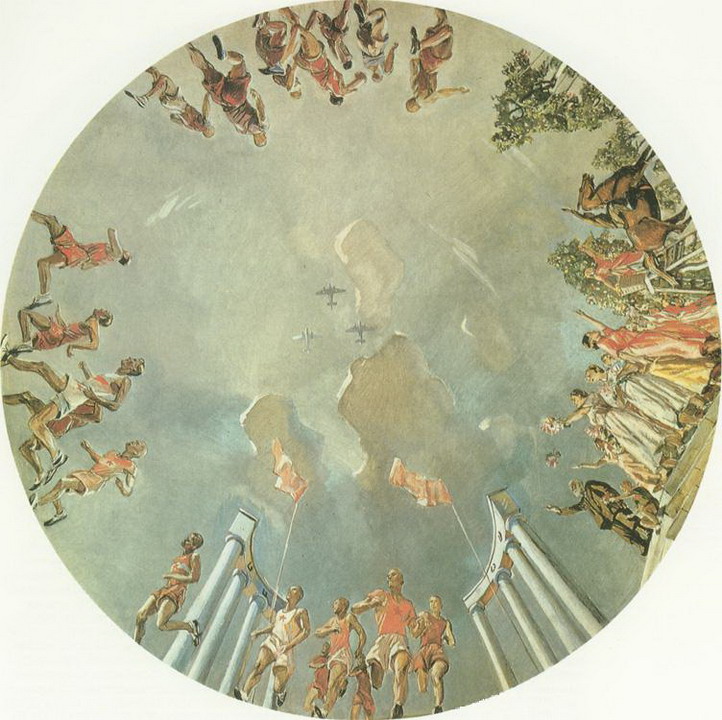
6 miles - 52.05 min - a bit windy, cool. Still, I could feel the blistering sun on my skin when clouds parted at times. I did put sun lotion on my nose and cheekbones, they are the first to catch sun, but it was more to protect against wind. (Picture: Boys running out of water by Alexander Deyneka)
Yes, it is Summer and I strip layer after layer to stay cool. Runner's World has published an article 'Should I run naked?' by Amby Burfoot.
If you ask me, the ancient Olympians were a lot cleverer than we are, she says. They had the good sense to run, jump and throw in the nude. When you put anything between your skin and the environment, such as shorts and a singlet, you only decrease your body's cooling efficiency (even if you're more comfortable in certain areas). The so-called “modern” Olympians of 1896 were cleverer than us, too. They did their running, jumping and throwing in April. Some athletes complained about the chilly, damp weather, but Spiridon Louis gave thanks to Zeus all the way to his (clothed) marathon victory in 2:58:50.
The article is more about the hydration and heat challenges facing summer marathon runners, than nudity, but the idea is there. Some advice and caution from the article:
Too Much Perhaps no runner has thought more about heat training and racing than Alberto Salazar. Before the 1984 Olympic Marathon he got tested in a heat chamber (where sweat production is measured) and learned to chug two litres of fluid before every workout. But then he crashed. He now believes he did too many hard 20-milers in the heat. "I was exhausted from the first step of the marathon," he says. He finished 15th in 2:14:19.
Hydration :
Everyone knows drinking fluids is supposed to help you run faster. But you have to slow down to grab your drinks. America's Steve Spence worked on this dilemma when he was training for the hot, humid World Championships Marathon in Tokyo in 1991. Spence set up a water table on his local track, and then practised drinking while running intervals at faster-than-marathon pace. "I figured if I got good at taking my drinks at this pace, it would come easy in the marathon," he says. Spence claimed the bronze medal.
And of course, Cool Clothing:
You already know that a white shirt will absorb less heat than a black one. <...> In 2000, Nike produced a shirt that several runners wore in the Sydney Olympics. This white shirt sat off the skin on small bumps (allowing air to circulate), was constructed of a large fishnet weave (more air circulation), didn't absorb sweat (leaving it on the skin to cool you via evaporation), and was made of recycled plastic bottles. Too bad Nike called the shirt the Stand-Off Distance Singlet (because of the way it stood off your skin), which sounded too much like a shirt with a body-odour problem. They then went on to produce something called the Nike Sphere Cool Marathon Singlet, with aerodynamic seam placement, mesh construction, and 'Zoned Venting' technology. But give me a Stand-Off Distance Singlet, and I'll show you a really great hot-weather running shirt.
And now we're coming back to what was promised in the title:
Here's my advice <...>: cut your racing singlet as short as you can. Research by exercise physiologist Timothy Gavin has shown that 'the chimney effect' can improve body cooling. This refers to air moving up the bottom of your untucked shirt and out the top.
Or just run naked. You'll be reconnecting with your Olympic forebears, increasing your chances of a medal, and giving a big boost to the BBC's TV ratings.
It looks like Nike got wind of the advice. Here's their video on naked running: